Jonah and Nineveh Bible story for kids
Even the Cows Wore Sackcloth. A gentle, age-appropriate audio retelling for calm family listening and bedtime.
Jonah 3-4. A 6-minute story for ages 3-8, about 9 minutes to read aloud.
Free audio preview
Hear the first two minutes of the narration, free and with no sign-up.
0:00 / 2:00

Keep listening in the app
Hear all 6 minutes with a subscription, which opens all 106. 6 stories are free, with offline listening and bedtime mode.
A little setup, without giving away the story
God gives Jonah a second chance to go to Nineveh, an enormous city that has been cruel for a long time. This time he goes and says one sentence, and what happens next makes Jonah angrier than the storm ever did.
Listen for these moments
- 1The one-line sermon Jonah preaches
- 2What the king of Nineveh does when he hears it
- 3The little worm and the big question at the end
Jonah and Nineveh
The whole story: Jonah 3-4, retold for ages 3-8, about 9 minutes to read aloud
God said it twice.
That is the part people forget. God had told Jonah once already — go to the great city of Nineveh — and Jonah had gone the other way, as far the other way as a ship could carry him. And God came back, and said the very same thing again.
He had been in the water, and in the dark, and God had brought him back out onto dry land. And now, here it was again. Go.
So this time, Jonah went.
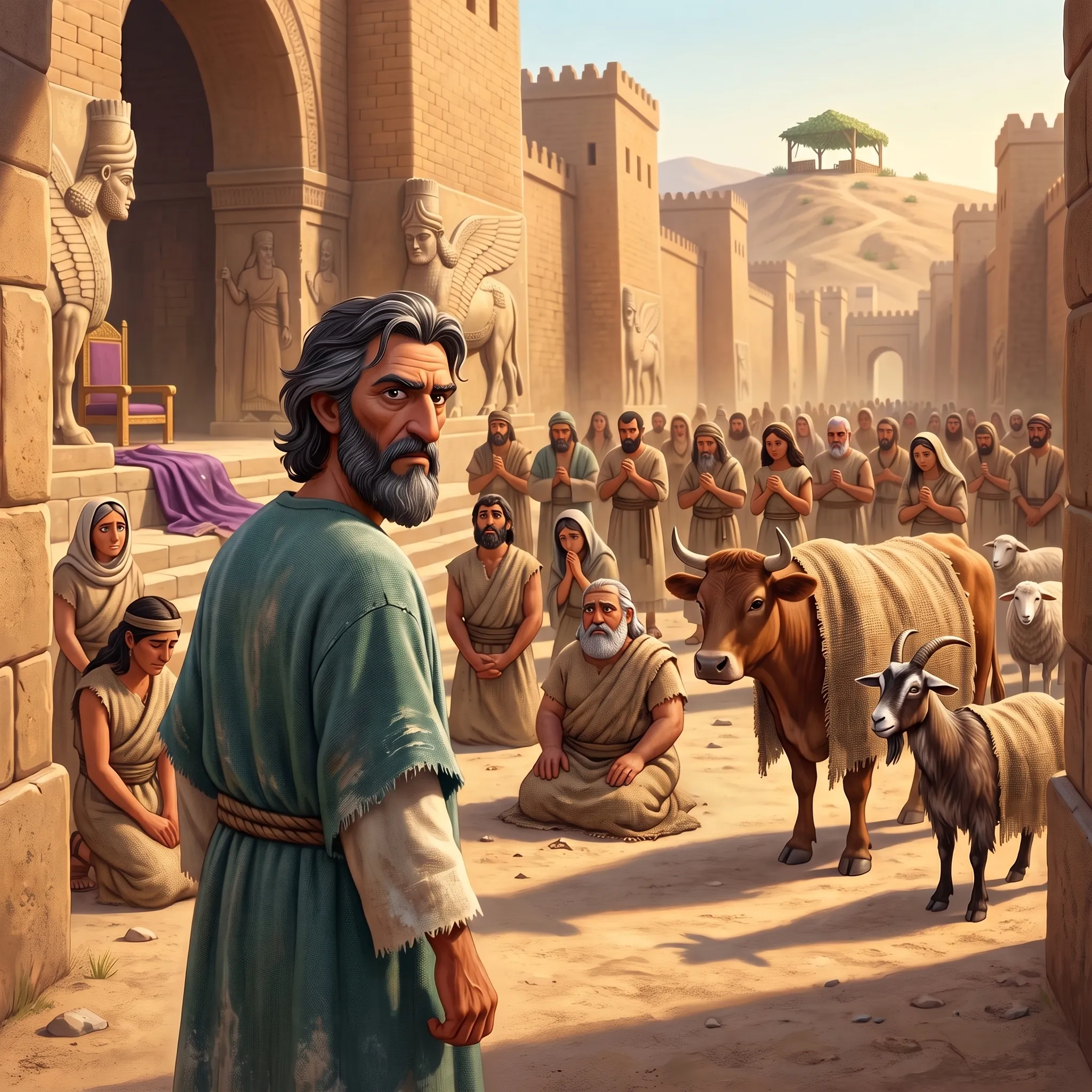
Nineveh was enormous. The Bible says it was so big it took three whole days just to walk across it — three days of streets and houses and gates and markets and people, people, people.
Jonah walked into it for one day. Not three. One. And as he walked, he said this.
Forty more days, and Nineveh will be overthrown.
That was it. That was the whole sermon. He did not explain what he meant. He did not tell anybody to say sorry. That is every word of it the Bible writes down. He said his one line, and he kept walking.
Because the way that city had been living could not go on. Nineveh had been a cruel city. The people there had hurt other people, and they knew it.
And they believed him.
Not one person. Not a handful. Everyone — the greatest of them and the least of them, the ones in big houses and the ones in small ones. Nobody in Nineveh ate a thing that day. And they put on sackcloth, which is the scratchiest, itchiest cloth anybody owned, the kind you would make a sack out of and never, ever a shirt.
The news went up through the streets and up through the big houses until it reached the king himself. The Bible never tells us his name. And when it reached him, the king stood up off his throne, took off his royal robe, pulled on a scratchy sack like everybody else, and sat down in the dust.
A king. On the ground.
And then the order went one step further.
The king and his important men sent a decree out into every street of Nineveh. Let every single person wear sackcloth, it said. And let the animals wear it too.
The cows. The sheep. The goats.
Imagine that, little one. A great big brown cow standing in a scratchy brown sack, looking out over the top of it. Mooo. A goat in a sack, extremely confused, complaining about it. Baaa. A whole city of people and a whole city of animals, all dressed the same, all saying sorry together.
And the decree did not end with a promise. It ended with a question. Who knows? Who knows but that God might turn, and not be angry with us after all.
And God saw them. God saw a whole enormous city turn itself right around.
And God did not do it. The forty days went by, one after another after another after another. And Nineveh was still standing.
Do you remember the proud general from Syria who washed seven times in a muddy little river, and went home knowing whose God was real? He wasn't one of God's people either. That was one man. This was a hundred and twenty thousand.
And Jonah was furious.
Everything in the story gets small now. A whole enormous city, a hundred and twenty thousand people, and the story shrinks all the way down to one cross man walking out the east gate.
He climbed a hill outside the city. He built himself a little shelter out of branches, and he sat down in its shade, and he waited to see what would happen.
And now — only now, sitting on that hill — Jonah finally says why he ran in the first place. He tells God: I knew it. I knew You were like this. I knew You would forgive them.
Then God asks him a question. Is it right for you to be angry? And Jonah does not answer. Not one word.
So God arranged something. A plant came up over Jonah's head — up and up, broad green leaves, cool shade right where he was sitting.
And Jonah was glad about it. Very glad. It is the only time in the whole book that Jonah is happy.
But before the sun was properly up the next day, God sent a worm. Just one. And by morning the plant was a brown, curled-up thing lying on the ground with one leaf still hanging on. That was all that was left of it.
Then the sun came up hot and white, and a dry wind came in off the east, and it beat down on Jonah's head until he could hardly sit up. And Jonah told God he was finished. He did not want any of it any more.
And God asked him one more question. Is it right for you to be angry about the plant?
And Jonah said it was.
Then God said the last thing in the book.
You cared about that plant. You did not plant it. You did not water it. You did not make it grow. It came up in one night, and it was gone in one night. And should I not care about that great city? There are more than a hundred and twenty thousand people in it who cannot tell their right hand from their left.
And also all those animals.
And that is where the story stops. Jonah does not say anything back. Not yes, not no, not one word. The book just... ends, with God still asking.
I wonder what that was like, sitting on a hot hill with a question like that. The Bible does not tell us. It only tells us what God said last. That He cared about a whole city of strangers who had never learned any better.
And about all those animals, too.
And God was with him. God was with her. God is with you, too.
Wonder with me, little one. May the same God who cared about a whole city of strangers, and every last one of their animals too... keep asking after you.
Keep listening in the app
Hear all 6 minutes with a subscription, which opens all 106. 6 stories are free, with offline listening and bedtime mode.
Quick answers about Jonah and Nineveh
- What did Jonah tell the people of Nineveh?
- "In forty days, Nineveh will be overthrown!" (Jonah 3:4). The people believed God, fasted, and put on sackcloth, from the greatest to the least (Jonah 3:5).
- Why did the animals in Nineveh wear sackcloth?
- The king and his nobles made a decree that people and animals alike should fast and be covered with sackcloth while everyone turned from their evil ways (Jonah 3:7-8).
- Why was Jonah angry when God forgave Nineveh?
- Jonah said this was why he had run away: he knew God was gracious, merciful, slow to anger and full of loving kindness, and would hold back from punishing the city (Jonah 4:1-2).
Talk about it together
Questions to ask
- The whole city, even the cows and goats, wore scratchy sackcloth to say sorry. What are some ways you show someone you are sorry?
- Jonah was angry that God forgave Nineveh. Why can it be hard to feel glad when someone who was unkind is forgiven?
- Jonah was very glad about his shade plant and very upset when the worm ate it. What is something small you were sad to lose?
- The book ends with God asking Jonah a question, and Jonah never answers. What do you think Jonah should have said?
Jonah and Nineveh memory verse for kids
“Shouldn't I be concerned for Nineveh, that great city, in which are more than one hundred twenty thousand persons who can't discern between their right hand and their left hand; and also much livestock?”
A prayer for bedtime
Dear God, thank You for forgiving me when I say sorry. Help me be glad when You forgive other people too. Amen.
More Bible stories for kids
See every story
Jonah Runs from God
Jonah 1, 7 min, ages 3-8

Jonah and the Whale
Jonah 2, 4 min, ages 3-8
Noah's Ark and the Great Flood
Genesis 6-9, 7 min, ages 3-8