Exodus 3-4
Moses and the Burning Bush Bible story for kids
Moses Meets God. A gentle, age-appropriate audio retelling for calm family listening and bedtime.
Free audio preview
Hear the first two minutes of the narration, free and with no sign-up.
0:00 / 2:00
Before you listen
A little setup—without giving away the story.
Forty years after running away from Egypt, Moses is walking the same dusty hills with the same sheep when a bush catches fire and simply refuses to burn up. What happens next turns an old shepherd who is sure he is nobody back toward the palace he fled.
Listen for these moments
- 1Why Moses has to take off his sandals
- 2The name God gives when Moses asks for one
- 3What God says to a man who stumbles over his words
A note for grown-ups
In one line the story says Moses had hurt someone very badly and had to run away, without any detail, and it names the Israelites still living as slaves in Egypt. If your child asks, it is enough to say Moses did something very wrong and ran, and that God still called him by name forty years later.
The whole story
Moses and the Burning Bush
Exodus 3-4 · retold for ages 3-8 · about 12 minutes to read aloud
Moses was eighty years old. His hair was gray. His sandals were worn thin. And every morning looked exactly the same — the same dusty hills, the same bleating sheep, the same wide empty sky. He'd been a shepherd for forty years now.
Baa. Baa. Baa.
That was his life now. Sheep.
A long, long time ago — forty years ago — Moses had been somebody important. He had grown up inside the palaces of Egypt. Pharaoh's own daughter had found him floating in a basket on the river when he was just a baby, and she had raised him like a prince. He learned everything the wise men of Egypt could teach him.
But Moses had made a terrible mistake. He had hurt someone very badly — and he had to run. He ran far, far away from Egypt, across the burning desert, all the way to a quiet little land called Midian. And there he stayed.
He married a kind woman named Zipporah. He took care of the sheep that belonged to her father, Jethro. And day after day, year after year, decade after decade — Moses walked the same dusty hills with his flock, under the same wide sky.
Nobody called him "prince" anymore. Nobody called him much of anything.
Sometimes, when the sheep were resting in the shade and the desert was very, very quiet, Moses would think about his people back in Egypt. The Israelites — God's people — still slaves. Still making bricks. Still crying out. And Moses would sit on a rock and stare at his old, wrinkled hands and wonder if God had forgotten about them.
If God had forgotten about him.
But God had not forgotten. Not even close.
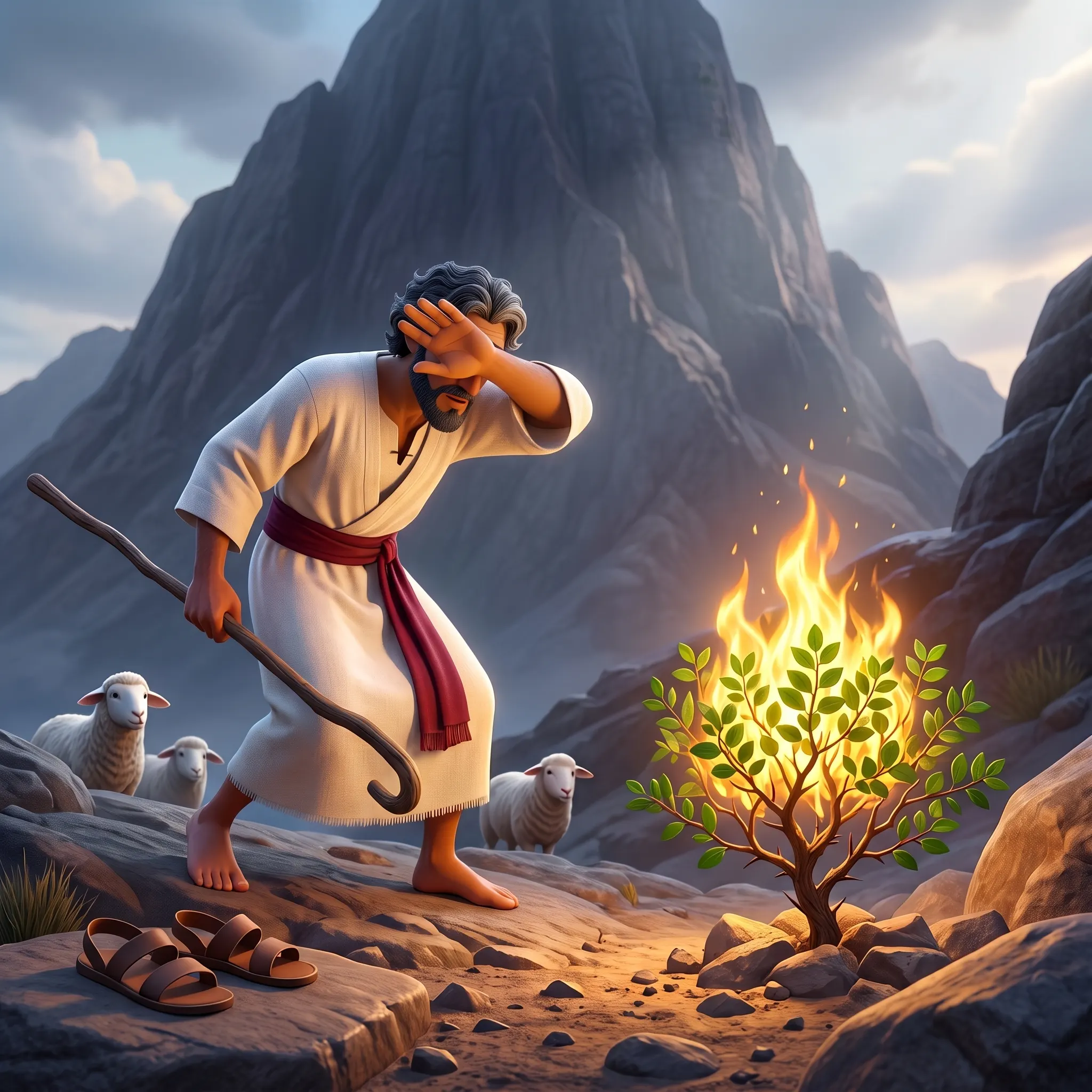
One ordinary morning — a morning just like every other morning — Moses led his sheep along the edge of the desert, toward a mountain called Horeb. Some people called it the mountain of God, though Moses didn't know why. It was just a mountain.
The sheep wandered ahead, nibbling tufts of dry grass. Moses leaned on his wooden staff and wiped the sweat from his forehead. The sun beat down. A lizard skittered across a rock. Nothing special. Nothing new.
And then Moses saw something strange.
Off to the side, between the rocks, a bush was on fire.
Now, bushes caught fire in the desert sometimes. The sun was hot, the air was dry, and little scrubby bushes would sometimes spark and crackle and burn up in a puff of smoke. Nothing unusual about that.
But this bush... this bush was different.
It burned and burned and burned — but it didn't burn up. The flames danced orange and gold and bright, bright white, licking around every branch and every twig. But the leaves didn't shrivel. The branches didn't crumble. The bush just kept burning, steady and bright, like a lantern that would never go out.
Moses stopped walking. He squinted. He tilted his head.
"That's... odd," he said to himself. "I will turn aside and see this great sight — why the bush is not burned up."
He took one step closer. Then another.
And then — a voice.
Right out of the middle of the fire. A voice deep and kind and enormous, like thunder wrapped in a blanket.
"Moses. Moses."
Moses' heart nearly stopped. His staff slipped in his sweaty hand. His knees wobbled. He looked left. He looked right. There was nobody there — just the bush, blazing away, and that voice.
"Here I am," Moses whispered.
And the voice said, "Do not come any closer. Take off your sandals. The place where you are standing is holy ground."
Holy ground. Right here, on this ordinary, dusty, stony hillside where the sheep wandered — holy ground. Because God was there.
Moses' hands shook as he bent down and pulled off his old, worn sandals. He felt the warm sand and stone under his bare feet. And he covered his face with his hands, because he was afraid to look at God.
And then God spoke again. And oh, what God said.
"I am the God of your father. The God of Abraham, the God of Isaac, and the God of Jacob."
Moses trembled. These were the names his mother had whispered to him when he was small — the great, great names from the old, old stories. Abraham, who counted the stars. Isaac, who laughed. Jacob, who wrestled with an angel. Their God — the real God, the living God — was speaking. To him. To an eighty-year-old shepherd with dusty feet and a flock of sheep.
"I have seen the suffering of my people in Egypt," God said. "I have heard them crying out. I know their pain. And I have come down to rescue them — to bring them out of Egypt to a good and wide land, a land flowing with milk and honey."
Moses' heart pounded. Rescue? After all these years?
"So now, go," said God. "I am sending you to Pharaoh. You will bring my people out of Egypt."
Moses almost laughed. Almost. But it wasn't funny — it was terrifying.
"Me?" Moses said. His voice cracked. "Who am I to go to Pharaoh? Who am I to bring the Israelites out of Egypt? I'm nobody. I'm an old man with sheep. I'm — I'm nothing."
And God said something that Moses would never, ever forget.
"I will be with you."
That was it. Not "you're strong enough." Not "you're smart enough." Not "you're young enough." Just — I will be with you.
But Moses wasn't done worrying. "If I go to the Israelites and say the God of their fathers sent me, they'll ask, 'What is His name?' What do I tell them?"
And God said, "I Am Who I Am."
"I Am. That is my name. Tell them I Am has sent you."
Not "I was." Not "I might be." I Am. Right here. Right now. Always.
Moses stood there, barefoot on holy ground, his face still hidden behind his hands. But he still wasn't sure.
"But Lord," he said, "what if they don't believe me? What if they won't listen?"
So God showed Moses wonders. "Throw your staff on the ground," God said.
Moses tossed his old wooden staff onto the sand — and it wriggled and twisted and turned into a snake. Moses jumped back so fast he nearly tripped over his own bare feet.
"Now pick it up by the tail," God said.
Moses reached down — slowly, carefully, with one eye closed — and grabbed the snake by its tail. And just like that, it was a staff again. Just wood. Just his old walking stick.
God showed him other wonders too — signs and marvels that would prove to the people that God had truly spoken to Moses. But Moses had one more worry. One more reason he wasn't the right person.
"Oh Lord," Moses said, and his voice was very small. "I am not a good speaker. I never have been. I am slow of speech. My words get tangled up. I stumble and stutter. Please... send someone else."
And God — patient, kind, enormous God — said this:
"Who made your mouth, Moses? Who makes a person able to speak, or not speak, or see, or not see? Is it not I, the Lord? Now go. I will be with your mouth. I will teach you what to say."
I will be with your mouth.
The same God who made the stars and set the sea in its place — that God would be with Moses' stumbling, stuttering, tangled-up mouth. And that would be enough.
God even gave Moses a helper — his brother Aaron, who was a good speaker. "He will speak for you," God said. "And I will be with both of you."
So Moses put his worn sandals back on. He picked up his old wooden staff — the one that had been a snake just a moment ago. He looked at the bush, still burning, still not burning up, bright and steady against the wide desert sky.
And he turned toward Egypt.
Eighty years old. Gray hair blowing in the desert wind. A staff in his hand and the voice of God ringing in his ears. Not because he was strong enough. Not because he was brave enough. Not because he had the right words.
But because God said, "I will be with you."
And that — little one — is how the greatest rescue in the whole Bible began. Not with an army. Not with a king on a golden throne. But with a burning bush, a pair of dusty sandals, and an old shepherd who thought he was nobody — until God called his name.
And God was with him. God was with her. God is with you, too.
May the same God who spoke to an old shepherd out of the middle of a fire... speak up for you when your own words won't come.
After the story
Talk about it together
Questions to ask
- Moses had watched the same sheep on the same hills for forty years before anything happened. What is something you do almost every single day?
- God told Moses to take his sandals off because the ground was holy. What do you think the warm sand and stone felt like under his bare feet?
- Moses told God he was not a good speaker and asked Him to send somebody else instead. When have you wished someone else would go first?
- God did not tell Moses he was strong enough or brave enough. He said, "I will be with you." Who makes you feel braver just by standing next to you?
Memory verse
“Now therefore go, and I will be with your mouth, and teach you what you shall speak.”
Exodus 4:12 · WEB
A prayer for bedtime
Thank You, God, for knowing my name and calling me Yours. When something feels too big for me, please stay close and help me go anyway. Amen.
Keep listening
More Bible stories for kids
Exodus 1-2
Baby Moses in a Basket
Exodus 14-15
Moses Crosses the Red Sea
Exodus 5-10