Exodus 5-10
Moses and the Plagues of Egypt Bible story for kids
Moses and the Nine Signs. A gentle, age-appropriate audio retelling for calm family listening and bedtime.
Free audio preview
Hear the first two minutes of the narration, free and with no sign-up.
0:00 / 2:00
Before you listen
A little setup—without giving away the story.
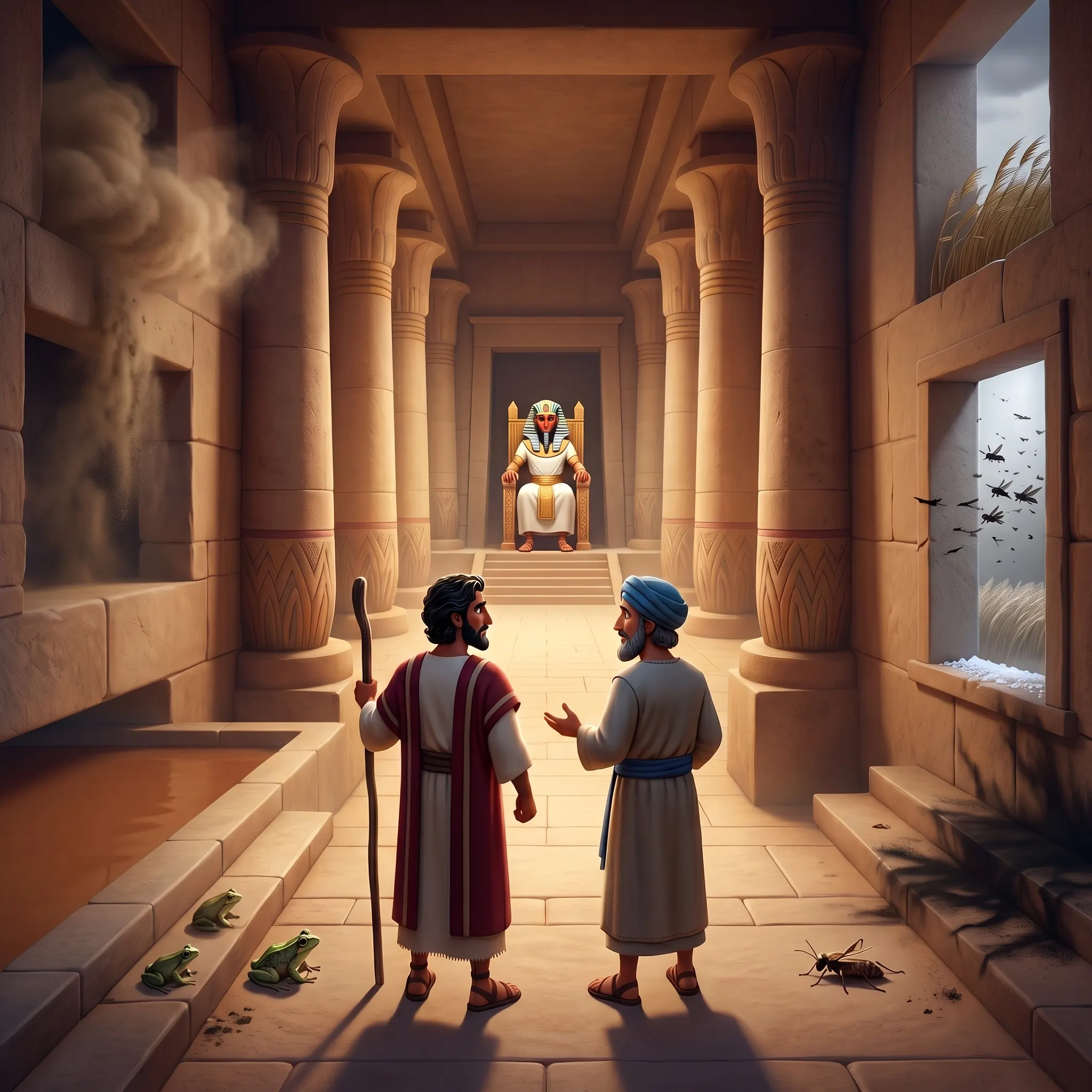
Nine times Moses walks into the golden throne room and asks Pharaoh to let God's people go, and nine times he gets the same one-word answer. Sign after sign piles up outside the palace while one man's heart stays as hard as the bricks his slaves are making.
Listen for these moments
- 1The one word Pharaoh keeps saying
- 2Everywhere the frogs manage to get into
- 3Why the sky over Goshen stays clear and blue
A note for grown-ups
The nine signs include the Nile turning to blood, animals dying of a sickness, painful sores, and hail that harms the people who ignore God's warning; each is named in a sentence or two and none is dwelt on, and the story closes with Pharaoh threatening Moses. The script is marked for ages five and up, and if your child asks why all of this happened, the story's own answer is that God had heard His people crying out under slavery and was moving to set them free.
How it begins
Moses and the Plagues of Egypt
Exodus 5-10 · retold for ages 5-8 · about 5 minutes to read aloud
"No."
That was Pharaoh's answer. Hard as stone. Cold as iron. Every time Moses walked into that golden throne room and said, "Let my people go," the answer was always the same.
No.
Pharaoh leaned forward on his throne and sneered. "Who is the Lord, that I should obey His voice? I do not know this God of yours. And I will not let Israel go."
Outside the palace, God's people — the Israelites — were slaves. They hauled bricks in the burning sun. They mixed mud and straw until their hands cracked and bled. Their backs ached. Their children cried. And every night, under the dark Egyptian sky, they whispered the same aching question. Did God hear them? Did God see them?
And God did hear them. Every whisper. Every cry. Every prayer that rose like smoke into the night.
That is why a bush had burned in the desert without ever burning up. That is why God sent Moses.
Moses stood before Pharaoh again. He was tall, with sun-weathered skin and steady eyes. His brother Aaron stood beside him. And in Moses' hand was a wooden staff — just an old shepherd's stick. But God had plans for that stick.
"Let my people go," Moses said.
Pharaoh yawned.
So Moses nodded to Aaron, and Aaron stretched his staff over the great River Nile — the river that all of Egypt depended on for water, for fish, for life itself.
And the water turned to blood.
The fish died. The river stank. No one in Egypt could drink from it. Up and down the land, people dug holes in the ground, hunting for water that was clean.
But Pharaoh? Pharaoh turned on his golden heel and walked back into his palace. He didn't even flinch.
"No," he said.
Seven days passed. The river slowly cleared. And Moses came back.
"Let my people go."
"No."
So Aaron stretched his staff over the rivers and the ponds and the streams. And up came the frogs.
Oh, the frogs. Now listen carefully, because this part is something else.
These were not cute little pond frogs sitting politely on lily pads. These frogs were everywhere. They hopped into the palace. They hopped into the kitchens. They plopped into the bread bowls where the bakers were kneading their dough — squish, squish, right in the middle of breakfast!
They jumped into the ovens. Can you imagine opening your oven to check on your bread, and a frog jumps out at you? They leaped into people's beds. Egyptians pulled back their blankets at night and — ribbit! — there sat a fat, wet frog, blinking up at them.
Frogs in your shoes. Frogs in your hat. Frogs on the throne. Frogs on the cat. Frogs on Pharaoh's golden plate right next to his dinner.
Even Pharaoh couldn't take it.
"Fine!" he shouted, waving frogs off his lap. "Pray to your God! Make them stop! And I will let your people go!"
Moses prayed. And God answered. The frogs died — in the houses, in the courtyards, in the fields. The Egyptians piled them up in great, stinking heaps.
But when Pharaoh saw that the frogs were gone... he changed his mind.
"No," he said. Again.
And so it went. Again and again and again.
The rest of the story is narrated in the app
You have read the opening. The full retelling of Moses and the Plagues of Egypt runs about 12 minutes, read aloud with music and gentle pacing for bedtime.
Listen to the full storyAfter the story
Talk about it together
Questions to ask
- Pharaoh said no again and again, even after he had promised to say yes. Why do you think it is so hard to admit you were wrong?
- The frogs got into the ovens, the beds, and even Pharaoh's dinner plate. Where would you least like to find a frog?
- The Israelites whispered to God in the dark and wondered whether He could hear them. Where do you go when you want to tell God something quietly?
- Moses had to walk back into that throne room and ask the very same question over and over. What is something you had to try more than once before it worked?
Memory verse
“Moreover I have heard the groaning of the children of Israel, whom the Egyptians keep in bondage, and I have remembered my covenant.”
Exodus 6:5 · WEB
A prayer for bedtime
Thank You, God, that You hear me even when I only whisper. Help me listen when somebody tells me the truth, and help me keep going when a good thing takes a long time. Amen.
Keep listening
More Bible stories for kids
Exodus 1-2
Baby Moses in a Basket
Exodus 14-15
Moses Crosses the Red Sea
Exodus 3-4