Joshua and the Battle of Jericho Bible story for kids
Joshua and the Trumpets at Jericho. A gentle, age-appropriate audio retelling for calm family listening and bedtime.
Joshua 6. A 8-minute story for ages 3-8, about 10 minutes to read aloud.
Free audio preview
Hear the first two minutes of the narration, free and with no sign-up.
0:00 / 2:00

Keep listening in the app
Hear all 8 minutes with a subscription, which opens all 106. 6 stories are free, with offline listening and bedtime mode.
A little setup, without giving away the story
God gives Joshua a plan for the locked-up city of Jericho, and it has no ladders, no battering rams and no swords. It has trumpets, a lot of walking, and a rule that nobody may say a single word.
Listen for these moments
- 1The rule Joshua gives about talking
- 2How many times they march on the seventh day
- 3The one small piece of wall where something red still flutters
A note for grown-ups
Jericho is a battle story, and although this telling shows no one hurt, the Bible chapter goes on to describe the city being destroyed. If an older child asks, it is fine to say plainly that it was a war, and then point to how carefully Joshua kept Rahab's family safe.
Joshua and the Battle of Jericho
The whole story: Joshua 6, retold for ages 3-8, about 10 minutes to read aloud
They didn't swing swords. They didn't shoot arrows. They didn't shout or scream or charge. They just... marched. Around and around and around a city with walls so thick that whole houses were built right inside them.
It began forty years earlier. God's people had been walking through the wilderness all that time — forty years of sand and sun and starlight. And now, at last, they stood at the edge of a new land — the land God had promised them, long ago.
But there was a problem.
Right in the middle of the way sat a city called Jericho. And Jericho was locked up tighter than a treasure chest. Huge stone walls rose up all around it — tall as trees. The gates were shut. The bars were bolted. Nobody went in. Nobody came out. The people inside were so afraid of God's people that they had sealed themselves in like seeds in a shell.
Joshua stood looking up at those walls. He was the leader now — Moses had passed the job to him before he died. And Joshua was brave. But those walls... those walls were something else.
"How?" Joshua must have wondered. "How do we get past walls like that?"
And then God spoke.
"Joshua," God said, "I have given you this city. Here is what you will do."
Now, if you were planning to knock down a wall, what would you try? A battering ram? A big ladder? Digging underneath?
But God's plan was different.
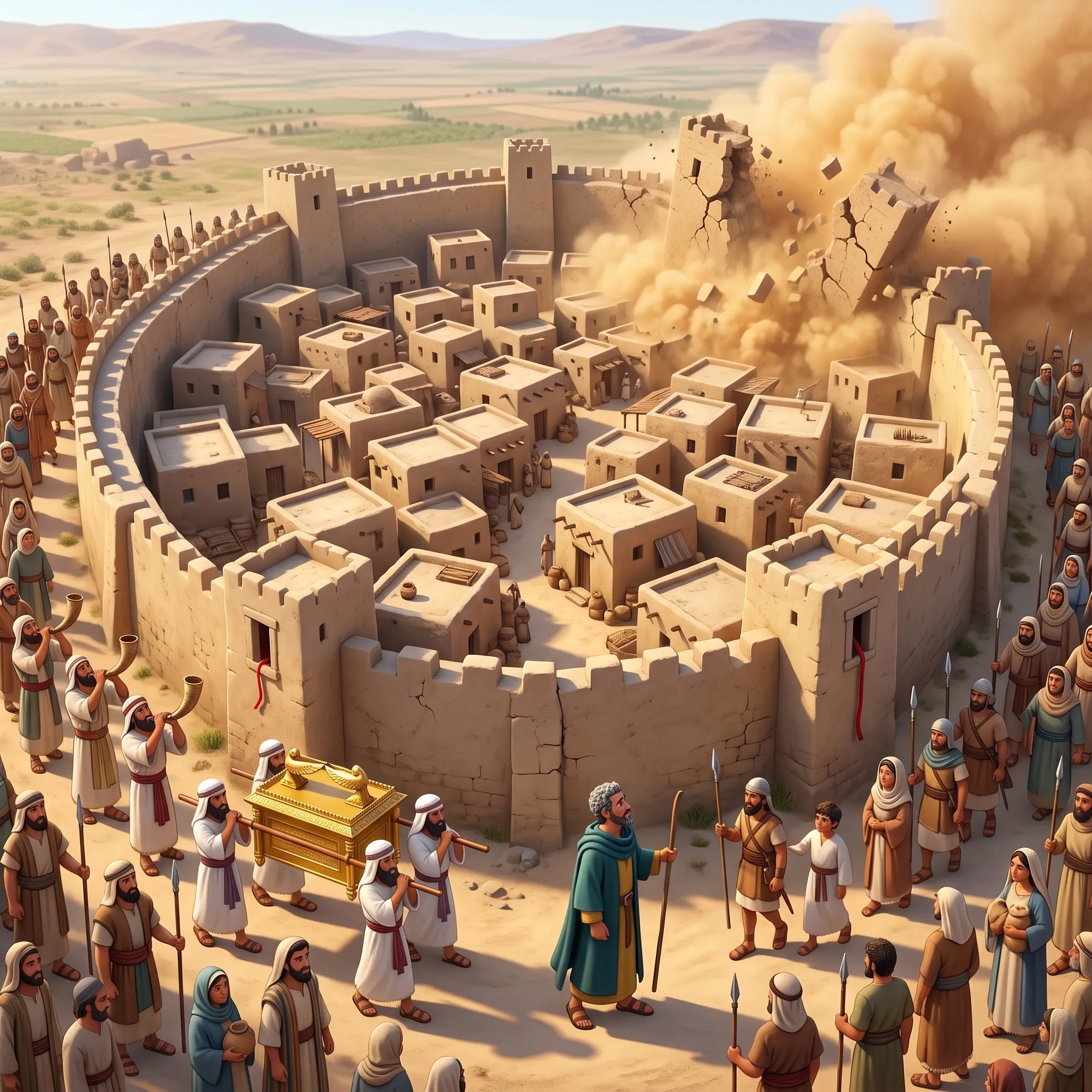
"March around the city," God said. "Once a day. For six days. Seven priests will walk in front of the ark of the covenant, carrying seven trumpets made of ram's horns. Armed men will march in front of them all. The rest of the people will follow behind."
Joshua told the people God's plan. And then he gathered them close, as if sharing a secret, and told them one more thing.
"No one is to say a word. Not a shout. Not a whisper. Not a single sound from any mouth — until I tell you to shout."
Can you imagine? A whole army — thousands and thousands of people — and not one of them allowed to speak. Not one peep.
And do you know what? They did it. They lined up. The armed men went first. Then the seven priests, each holding a ram's horn trumpet. Then came the ark of the covenant — that beautiful golden box that reminded everyone that God was right there with them. And then came everyone else, walking in a long, long line.
The trumpets blew. The feet marched. And not one person said a word.
Around the city they went. All the way around. The people up on the walls of Jericho must have stared down with the strangest looks on their faces. An army... just walking? Just blowing horns?
And then, when they had gone all the way around — once — they stopped. They turned around. And they went back to camp.
That was it. Day one.
The next morning, they got up and did it again. Same march. Same trumpets. Same silence. All the way around — once — and back to camp.
Day two. Done.
Day three. Same thing.
Day four. Day five. Day six. Every single day, that army rose with the sun, lined up in order, and marched around those mighty walls without saying a word. The trumpets blew. The dust rose under their feet. The people of Jericho watched from above. And still — not one Israelite opened their mouth.
Six days of silence. Six days of marching. Six days of trusting a plan that must have seemed very, very strange.
I wonder if some of them felt silly. I wonder if some of them thought, "Is this really going to work?" But they kept marching. They kept trusting. They kept their mouths shut and their feet moving.
And then came day seven.
On the seventh day, they woke up early. Before the sun had even cleared the hills. And this time, God's instructions were different.
"Today," Joshua told the people, "you will march around the city seven times."
Seven times! That's a lot of marching. Around and around and around. The trumpets blowing. The feet stomping. The dust swirling. One lap. Two. Three. Four. Five. Six.
And the seventh time around — the priests blew one long, mighty blast on their trumpets.
And Joshua lifted his voice and cried out, "Shout! For the Lord has given you the city!"
And the people shouted. Oh, how they shouted! After six days of silence, the sound that came from their mouths was like thunder rolling across the sky. Every voice. Every throat. Every man, woman, and child — all at once.
The ground trembled.
The air shook.
And the walls of Jericho — those great, thick, impossible walls —
They fell down flat.
Not a crack here and a crack there — the great wall came tumbling down like a sandcastle in the waves. Dust billowed into the sky. And where the gates had been shut up tight, there was nothing but rubble and open sky — all but one small piece, high up, where a red cord still fluttered.
The people walked straight in.
But listen now — this is important. Before any of that happened, Joshua had given a special order. There was a woman in Jericho named Rahab, and she was brave. She had helped two Israelite spies and hidden them on her roof. She had believed in God when no one else in Jericho did. And the spies had made her a promise: tie a red cord in your window, and when we come back, your family will be safe.
And she did. That red cord hung in her window, bright against the stone.
"Go to Rahab's house," Joshua told the two spies. "Bring her out. Bring her whole family. We made a promise, and we will keep it."
And so, while the dust was still settling, those two spies found the house with the red cord in the window — and they brought Rahab out. Her mother, her father, her brothers and sisters. Safe. Every single one.
Rahab and her family came to live with the people of Israel. She became part of God's family — and her name was remembered for a long, long, long time. All the way to the story of Jesus himself.
And Joshua? Joshua stood in the settling dust and looked at what God had done. Not with battering rams. Not with ladders. Not with anything that made sense to anyone — except God.
Just marching. Just trumpets. Just trust.
You know, little one... sometimes the right thing to do looks a little silly. Sometimes trusting God means doing something that doesn't make sense to anyone else. Walking when everyone says you should run. Being quiet when everyone says you should shout. Waiting when everyone says you should hurry.
But Joshua and his people marched. They blew their trumpets. They trusted the plan, even when it seemed strange. And the walls came down.
The dust has settled. The trumpets are silent. And the quiet land is at peace.
And God was with him. God was with her. God is with you, too.
Settle in, little one. May the same God who brought the walls of Jericho tumbling down walk with you through every wall you face.
Keep listening in the app
Hear all 8 minutes with a subscription, which opens all 106. 6 stories are free, with offline listening and bedtime mode.
Quick answers about Joshua and the Battle of Jericho
- How many times did the Israelites march around Jericho?
- Once a day for six days, then seven times on the seventh day, thirteen times in all (Joshua 6:3-4, 6:15).
- What made the walls of Jericho fall down?
- After the priests blew the trumpets and the people gave a great shout, the wall fell down flat (Joshua 6:20). The Bible presents it as God's doing, since He had already told Joshua He had given them the city (Joshua 6:2).
- What happened to Rahab when Jericho fell?
- Joshua sent the two spies to bring out Rahab and all her family, keeping the promise they had made her, and she lived among Israel from then on (Joshua 6:22-25).
Talk about it together
Questions to ask
- Nobody was allowed to say a single word for six whole days of marching. How long do you think you could stay quiet?
- Some of the people may have felt silly walking around the walls and blowing horns. Have you ever done the right thing even when it felt a little silly?
- After six days of silence, everyone shouted at once. What do you think that sounded like to the people on top of the wall?
- Joshua made sure the spies kept their promise to Rahab while the dust was still settling. Why does it matter so much to keep a promise?
Joshua and the Battle of Jericho memory verse for kids
“Shout, for Yahweh has given you the city!”
A prayer for bedtime
Dear God, thank You for bringing down the walls of Jericho in Your own surprising way. Help me trust You and keep going, even when Your plan seems strange. Amen.
More Bible stories for kids
See every story
The Twelve Spies
Numbers 13-14, 8 min, ages 3-8

Joshua and the Day the Sun Stood Still
Joshua 10:6-14, 3 min, ages 3-8
Joshua Crosses the Jordan River
Joshua 3-4, 6 min, ages 3-8