Ruth and Naomi Bible story for kids
Where You Go, I Will Go. A gentle, age-appropriate audio retelling for calm family listening and bedtime.
Ruth 1. A 8-minute story for ages 3-8, about 9 minutes to read aloud.
Free audio preview
Hear the first two minutes of the narration, free and with no sign-up.
0:00 / 2:00

Keep listening in the app
Hear all 8 minutes with a subscription, which opens all 106. 6 stories are free, with offline listening and bedtime mode.
A little setup, without giving away the story
Naomi has lost her husband and both her sons in a faraway land, and now she wants to go home to Bethlehem. Where the road splits, she tells her two daughters-in-law to turn back, and each of them has to choose.
Listen for these moments
- 1The news Naomi hears from a passing traveler
- 2What Orpah does at the fork in the road
- 3The new name Naomi asks to be called
A note for grown-ups
Naomi's husband and both of her sons die early in the story, and the grief is named rather than skipped. Let your child sit with that sadness for a moment, then notice that Ruth's choice means Naomi is not alone, and that they reach Bethlehem just as the barley harvest begins.
Ruth and Naomi
The whole story: Ruth 1, retold for ages 3-8, about 9 minutes to read aloud
Three women stood on a road that split in two directions. Behind them: everything they knew. The graves of the people they loved. The houses where they'd been happy. Ahead of them: a long, long walk to a place two of them had never seen.
They had walked a long way to reach that road. And the walking started years before, in a little town called Bethlehem.
A long time ago, in that little town, there lived a family. A mama named Naomi, a papa named Elimelech, and two boys. They had a good life — bread on the table, stars above the roof, and neighbors who knew their names.
But then... the rain stopped coming. The wheat dried up. The bread ran out. A terrible famine had come to the land.
So the family packed up everything they had and walked a long, long way to a country called Moab. It was a strange land, with strange foods and strange words. But there was bread there. And that was enough.
The two boys grew up tall and strong. They fell in love with two young women from Moab. One was named Orpah. And the other... was Ruth.
Oh, Ruth loved her family. She loved Naomi — her husband's mother — the way you love someone who teaches you to laugh and tells you stories and saves the last bit of honey cake just for you. Naomi was like a second mama to her.
But then... sadness came. The kind of sadness that sits so heavy on your chest you can hardly breathe.
First, Elimelech died. And Naomi wept.
Then — oh, little one — both of the sons died, too. Naomi's boys. Ruth's husband. Gone.
Three women, all alone. No husbands. No children. In a land far from home.
Naomi sat in her empty house and felt the emptiness press in from every side. And one morning, she heard something — a whisper of news from a traveler passing through. "The Lord has visited his people in Bethlehem," the traveler said. "The famine is over. The bread is back."
Naomi's heart ached. Home. She wanted to go home.
So she gathered her few things and she said to Ruth and Orpah, "Come. Walk with me to the edge of the road."
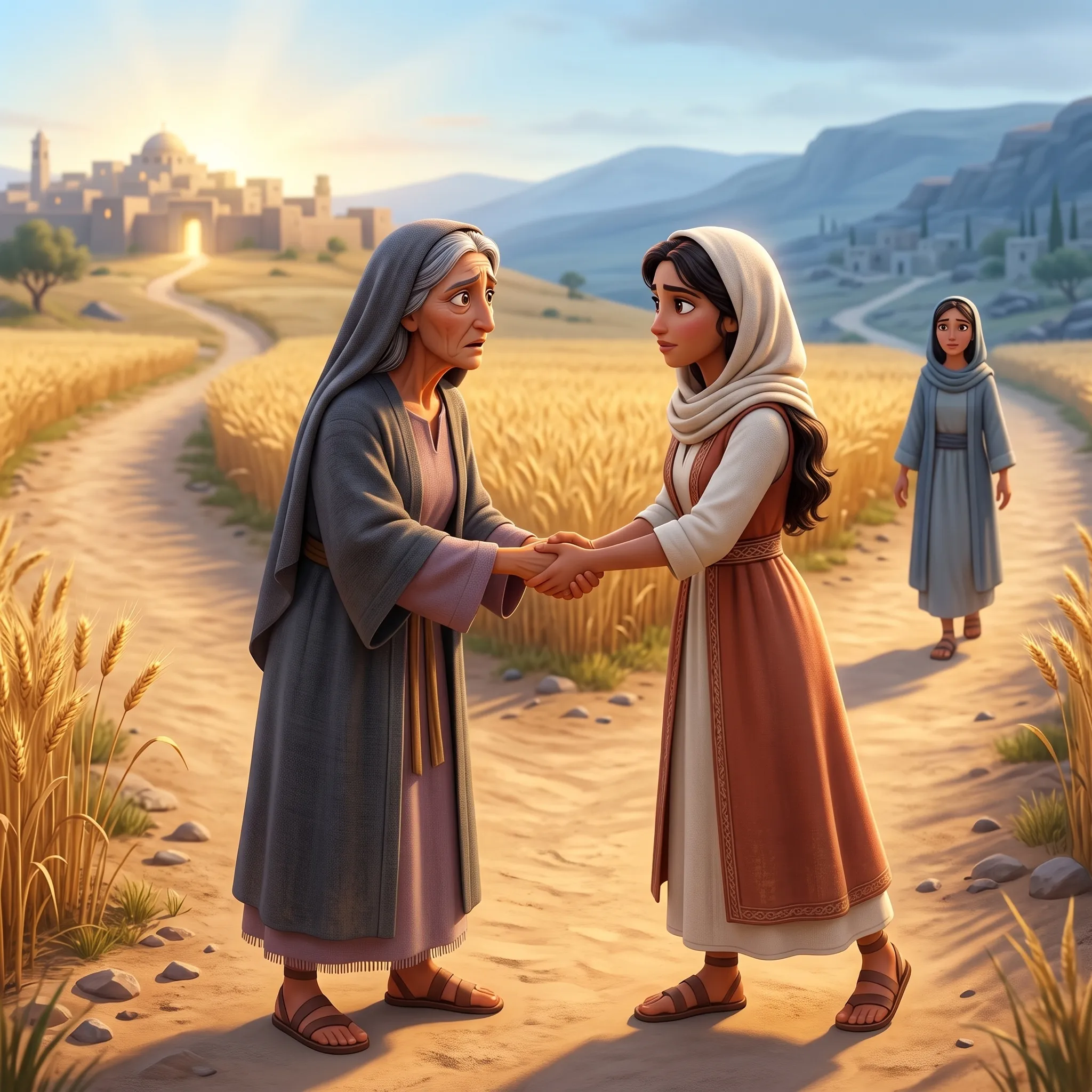
And they did. All three women walked together, their sandals scuffing the dry earth, the sun warm on their backs. They walked and they walked until they came to that place — the place where the road split in two.
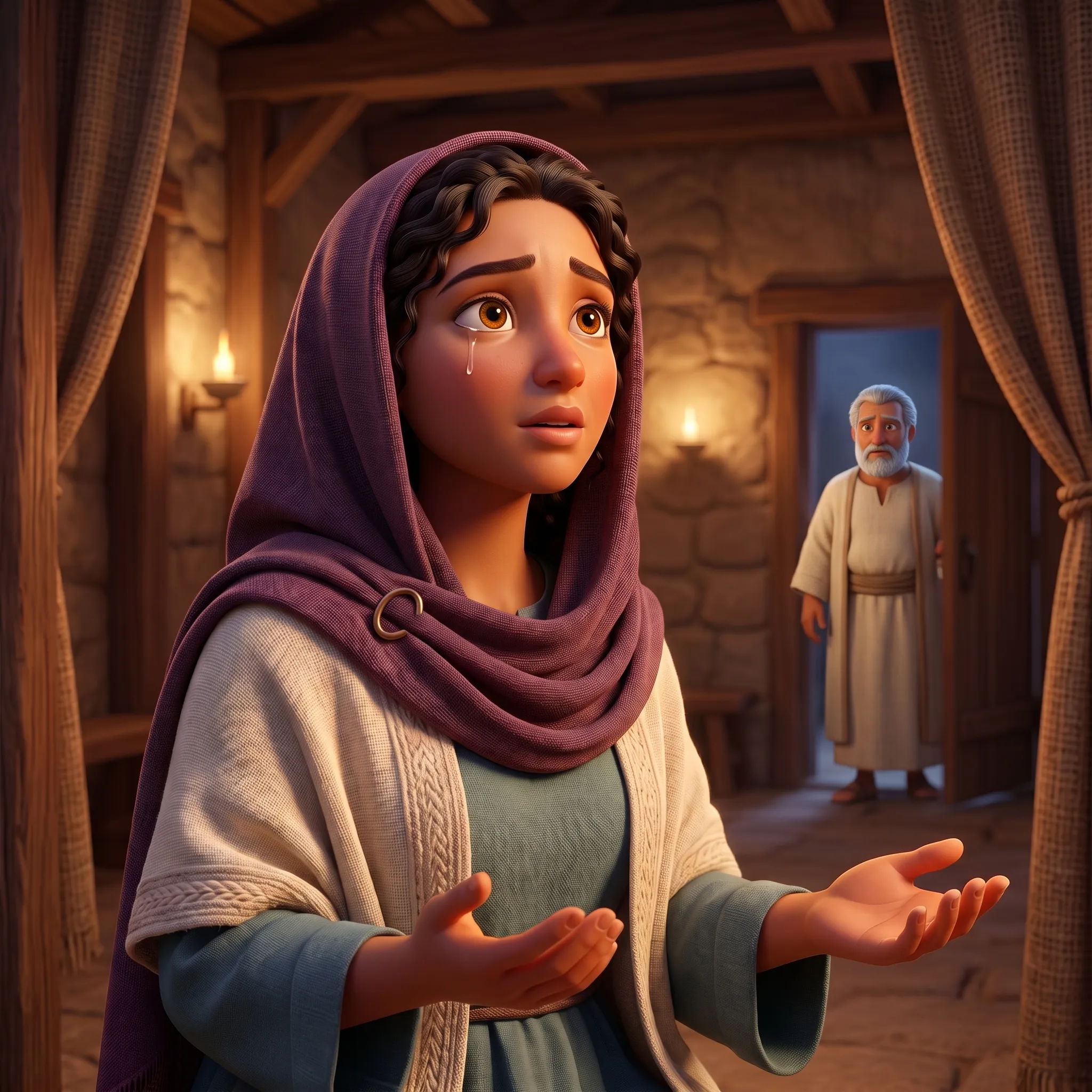
Naomi turned. She looked at these two young women she loved so dearly. And her eyes filled with tears.
"Go back," she said softly. "Both of you. Go back to your mothers' houses. You've been so kind to me. So kind to my sons. May the Lord deal kindly with you, the way you have dealt with me."
She kissed them. And all three of them stood there crying on that dusty road.
Both of them refused. "No," they said. "No, we'll go back with you, to your people."
But Naomi shook her head. "My dear girls, I have nothing left to give you. No more sons. No home waiting. Go back. Find new husbands. Start again. Please."
Orpah looked at Naomi. She loved her — she truly did. And she cried so hard her shoulders shook. Then she kissed Naomi one last time... and she turned around. And she walked back toward Moab. Back toward her family. Back toward everything she knew.
And that was not a wrong thing, little one. Naomi had told her to go. Sometimes love looks like letting go.
But Ruth...
Ruth did not move.
She stood there on that dusty road, her hands holding tight to Naomi's arm. And she would not let go.
"Look," Naomi whispered. "Orpah has gone back to her people and to her gods. Go with her."
But Ruth — oh, listen to what Ruth said. These might be the most beautiful words anyone has ever spoken to someone they love.
Ruth lifted her chin. And through her tears she said:
"Do not urge me to leave you or to turn back from following you. For where you go, I will go. And where you stay, I will stay. Your people will be my people. And your God... will be my God. Where you die, I will die, and there I will be buried."
Where you go, I will go.
She said it right there, on that fork in the road, with dust on her feet and tears on her cheeks. She chose. Not the easy road. Not the safe road. She chose love.
Ruth was a Moabite — a foreigner, an outsider. She had no family in Bethlehem. She had no friends there. She didn't know if anyone would even speak to her. But she looked at Naomi and she said: I will not leave you alone.
Naomi stared at her. She saw something in Ruth's eyes that was stronger than sadness. Stronger than fear.
And Naomi stopped arguing. She took Ruth's hand. And the two of them turned and began to walk.
They walked all day. They walked through valleys and over hills. They walked past olive trees and dry riverbeds. They walked until their feet ached and their water ran low. They walked until the stars came out. And then they kept walking.
And finally — finally — they saw it. A little town on a hillside, golden in the evening light. Bethlehem.
People came out to look. They squinted. They tilted their heads. And someone gasped.
"Is this... Naomi? Is that you?"
But Naomi shook her head slowly. "Don't call me Naomi," she said. Naomi meant "pleasant." "Call me Mara," she whispered. Mara meant "bitter." "I went away full — with a husband and two sons and a heart full of hope. And the Lord has brought me back... empty."
But little one... was she really empty?
Because right there beside her, dusty and tired and loyal as the dawn... stood Ruth. Ruth who had left everything behind. Ruth who had said, "Where you go, I will go."
Naomi had lost so much. But she had Ruth. And that was not nothing. That was everything.
And do you know when they arrived? The Bible says they came to Bethlehem at the very beginning of the barley harvest. The fields were golden. The grain was ripe. It was the season of bread coming back, of tables being filled, of empty things being made full again.
It was a beginning.
Not an ending. A beginning.
God walked it with them — the dusty road, the fork where they chose, and all the way home to Bethlehem. Every single step.
And God was with him. God was with her. God is with you, too.
Rest well, little one. May the same God who met Ruth at the fork in the road meet you at every road you ever walk.
Keep listening in the app
Hear all 8 minutes with a subscription, which opens all 106. 6 stories are free, with offline listening and bedtime mode.
Quick answers about Ruth and Naomi
- Why did Naomi's family leave Bethlehem?
- There was a famine in the land, so Naomi, her husband Elimelech and their two sons went to live in Moab (Ruth 1:1-2).
- Why did Naomi want to be called Mara?
- Mara means bitter. Naomi said she had gone away full and the Lord had brought her back empty (Ruth 1:20-21).
- Did Orpah do something wrong by going back?
- The Bible does not blame her. Naomi urged both young women to go home, and Orpah kissed her goodbye and returned to her people (Ruth 1:8-15).
Talk about it together
Questions to ask
- Naomi was like a second mama to Ruth, the kind who saves you the last bit of honey cake. Who is someone like that for you?
- Orpah cried and went back home, and the story says that was not a wrong thing. How can letting someone go be a way of loving them?
- Ruth held onto Naomi's arm and said, where you go, I will go. Who would you say that to, and why?
- Naomi felt empty when she got home, but Ruth was standing right beside her. What would you say to cheer up someone who feels the way Naomi did?
Ruth and Naomi memory verse for kids
“Where you go, I will go; and where you stay, I will stay. Your people will be my people, and your God my God.”
A prayer for bedtime
Dear God, thank You for the people who stay close to me when life is hard. Help me be a loyal friend like Ruth. Amen.
More Bible stories for kids
See every story
Ruth and Boaz
Ruth 2, 4 min, ages 3-8
Ruth's Baby Obed
Ruth 4, 3 min, ages 3-8
David and Jonathan
1 Samuel 18-20, 10 min, ages 3-8